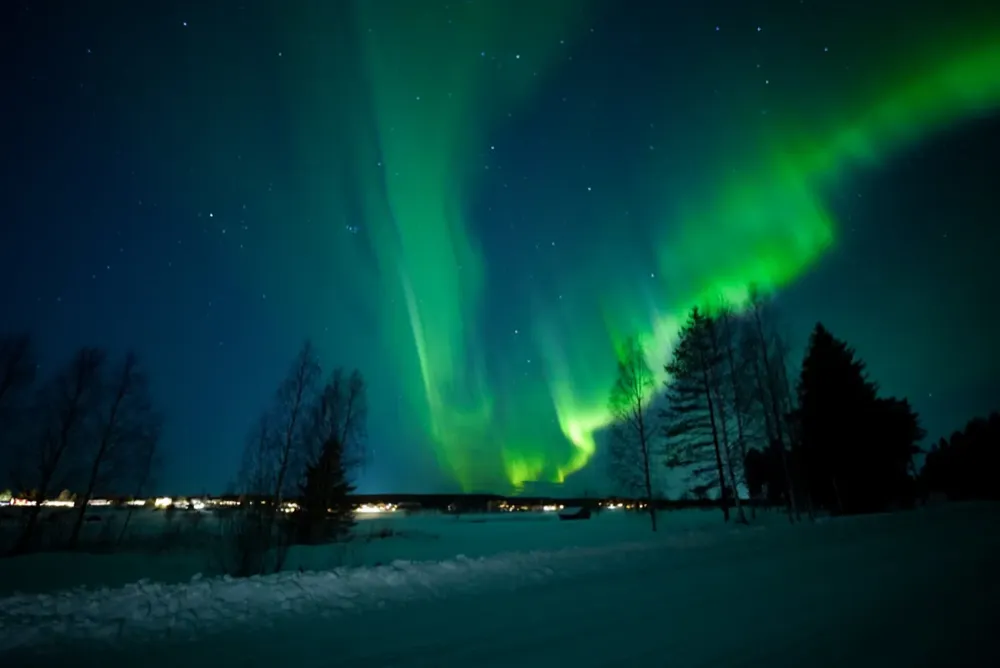
Quick answer: Yes — you can see the Northern Lights in Rovaniemi in autumn. The aurora season starts in late August, and September and October are statistically among the most active aurora months of the year. Autumn nights are dark enough, the weather is far milder than in winter (roughly +10°C in September to around 0°C in October instead of −20°C), and unfrozen lakes add something winter cannot: aurora reflections on open water. Tours run exactly as in winter — 5–8 hours, with professional photos and warm drinks included. We see the aurora on about 95% of tours. The guarantee applies from the first night of the season: if the guides’ cameras capture no aurora during your tour, you join another hunt free, as many times as you need, or take a full refund.
Key facts at a glance
| Autumn aurora season | Late August – November |
| Aurora activity | Statistically peaks around the September equinox |
| Typical temperatures | September evenings ~+5 to +10°C · October around 0°C (~+3 to −3°C), colder on clear nights |
| Best hours | ~9 PM – 1 AM (from ~10 PM in late August) |
| Daylight in October | 11 h 16 min on 1 October → 7 h 37 min on 31 October |
| What’s different from winter | Milder weather, little or no snow, aurora reflections on open lakes, fewer crowds |
| Included | Transport, warm drinks, professional photos |
| Experience Tours success rate | We see the aurora on about 95% of tours |
| Guarantee | No aurora on the guides’ cameras: another hunt free, as many times as you need, or a full refund |
When does the aurora season actually start?
The aurora itself never stops — it runs all year. What changes is darkness. Around the Arctic Circle, summer nights are simply too bright to see it. By late August, Rovaniemi gets its first properly dark hours back, and the season is open. From that point on, every clear, dark night is a chance.
Our Rovaniemi aurora forecast covers the next three nights: cloud across our whole driving range, space weather and the moon, updated every three hours.
Many visitors assume the Northern Lights are a “winter thing” and book December–February. Winter is excellent — but it is not when your odds begin, and in one measurable way it is not even when they peak.
The equinox effect: why September is statistically strong
Geomagnetic activity is not evenly distributed across the year. Decades of measurements show it peaks around the equinoxes — late September and late March — when the orientation of Earth’s magnetic field couples more efficiently with the solar wind. In practice: September nights produce, on average, more auroral activity than December nights. Our guide to the Kp index and Bz explains the mechanism, known as the Russell–McPherron effect.
Combine that with Rovaniemi’s position directly under the auroral oval, and an autumn hunt is not a compromise. It is one of the best windows of the whole season.
What an autumn aurora hunt looks like
The format is identical to our winter tours — we check live cloud and aurora forecasts, drive to the clearest skies, and stay out as long as the conditions require (usually 5–8 hours). What changes is the setting:
- Milder nights. September evenings are typically +5 to +10°C — a light jacket instead of a thermal suit. October sits around 0°C, colder on clear nights.
- Reflections on open water. Through September and most of October the lakes are still open. On calm nights the aurora mirrors on the surface — a shot that is only possible until the lakes freeze over.
- Autumn colours. In early September the ruska (autumn foliage) is still on the trees; the landscape under the aurora looks completely different from the white winter.
- Fewer crowds. High season starts in December. In autumn the roads, viewpoints and tours are noticeably quieter, and flights and hotels cost less.
Professional photos, warm drinks and transport are included exactly as in winter, and the guarantee applies from the first tour of the season: if the guides’ cameras capture no aurora during your tour, you join another hunt free, as many times as you need, or take a full refund.
October in Rovaniemi: darkness, moon and first snow
In October the nights grow quickly. Rovaniemi loses more than three and a half hours of daylight between the first and the last day of the month:
| 1 October | 11 h 16 min of daylight |
| 15 October | 9 h 35 min of daylight |
| 31 October | 7 h 37 min of daylight |
Dark evenings come earlier every week, so in October a hunt can start earlier in the evening than in September. On Sunday 25 October the clocks go back one hour, and from then on darkness arrives an hour earlier by the clock.
The moon is the other variable. In October 2026, new moon is on 10 October, and from 13 to 18 October the moon does not rise at all in Rovaniemi, so those nights have no moonlight. Full moon is on 26 October; from 22 to 29 October the moon is more than 80% illuminated and above the horizon throughout the evening tour hours.
The moon does not cancel the aurora. A strong display still shows through moonlight; a faint one fades into the brighter sky. The photographs look different too: the landscape is lit and fewer stars show. Bright and dark nights by date are in the moon calendar on our forecast page.
October is usually also when the first snow comes. According to the Finnish Meteorological Institute, the first snow cover in Rovaniemi typically arrives in the second half of October (around 21 October on average), and the permanent winter snow cover usually settles in the first half of November (1991–2020 averages).
September vs. October vs. November vs. winter
| September | Mildest weather, equinox activity peak, lake reflections, ruska colours. Nights get dark from ~10 PM. |
| October | Nights lengthen fast, still no deep cold, first snow usually in the second half of the month. A quiet, high-odds month. |
| November | Daylight falls from about 7.5 hours to under 4 by the end of the month. The permanent snow cover usually settles in the first half of the month and the larger lakes freeze. Long nights; cloud is the main variable. |
| December–March | Longest nights, snowy landscapes, coldest temperatures, busiest season. Excellent — but book early and dress for −20°C. |
There is no wrong choice here — the aurora does not care about the calendar, and neither does our guarantee. The honest summary: winter gives you snow; autumn gives you comfort, reflections and equally strong lights.
What to wear in autumn
Far less than in winter, but nights cool down and a hunt means hours of standing and waiting outside. Layers matter more than any single garment:
- Layers. Several thin layers rather than one thick one, so you can add or remove as the night cools.
- September: evenings are around +5 to +10°C. A warm mid-layer and a windproof jacket are enough.
- October: nights are around freezing and colder when the sky is clear. Add a thermal base layer under the mid-layer and warm trousers.
- Warm hat and gloves. Bring them for every October hunt and for late September nights.
- Shoes you can stand still in for a long time. Insulated shoes or boots and warm socks; feet get cold first when you stand and wait.
- The heated vehicle is always nearby, so you can step inside and warm up whenever you like.
We don’t hand out overalls, and on this tour you don’t need them.
Frequently asked questions
Can you see the Northern Lights in Rovaniemi in September?
Yes. The season opens in late August, and September is statistically one of the most active aurora months thanks to the equinox effect.
Is autumn better than winter for the Northern Lights?
The lights themselves are at least as active; September activity statistically exceeds December’s. Winter offers snow and longer nights, autumn offers milder weather, lake reflections and fewer crowds. Both work — our success rate and guarantee are the same year-round.
Is there snow in Rovaniemi in autumn?
Usually from the second half of October. According to the Finnish Meteorological Institute, the first snow cover in Rovaniemi typically arrives around 21 October, and the permanent winter snow cover usually settles in the first half of November. September and early October are green and orange (ruska), not white.
How cold is it on an autumn tour?
Typically +5 to +10°C on September evenings and around 0°C in October, colder on clear nights and towards the end of the month. Normal outdoor clothing in layers is enough, and the heated vehicle is always nearby. See what to wear.
How dark is it in Rovaniemi in October?
Daylight falls from 11 h 16 min on 1 October to 9 h 35 min on 15 October and 7 h 37 min on 31 October. On Sunday 25 October the clocks go back one hour, so darkness arrives an hour earlier by the clock.
When do the lakes freeze?
Usually from late October into November. According to long-term statistics from SYKE (the Finnish Environment Institute), small and medium-sized lakes in Lapland usually freeze by the end of October and the larger lakes during November. These are 1961–2000 averages; according to SYKE, freeze-up has moved later over the past century. Until then, calm nights can give aurora reflections on open water.
Do autumn tours include the same as winter tours?
Yes — transport, warm drinks, professional photos, and the same guarantee: if the guides’ cameras capture no aurora during your tour, you join another hunt free, as many times as you need, or take a full refund.
When do autumn tours start?
With the first dark nights in late August. Early-season dates are quieter than the winter peak, so pickup and small-group availability are at their best.
About Experience Tours
Experience Tours is a local Northern Lights and Arctic adventure operator based in Rovaniemi, Finnish Lapland. We run small-group and group aurora hunts with professional local guides, a money-back/free-repeat aurora guarantee, included professional photography, and a 4.9/5 rating from 760+ reviews. Tours run throughout the aurora season (late August–early April) and are guided in English; a Spanish- or French-speaking guide can sometimes be arranged on request.
Book your Northern Lights tour in Rovaniemi.