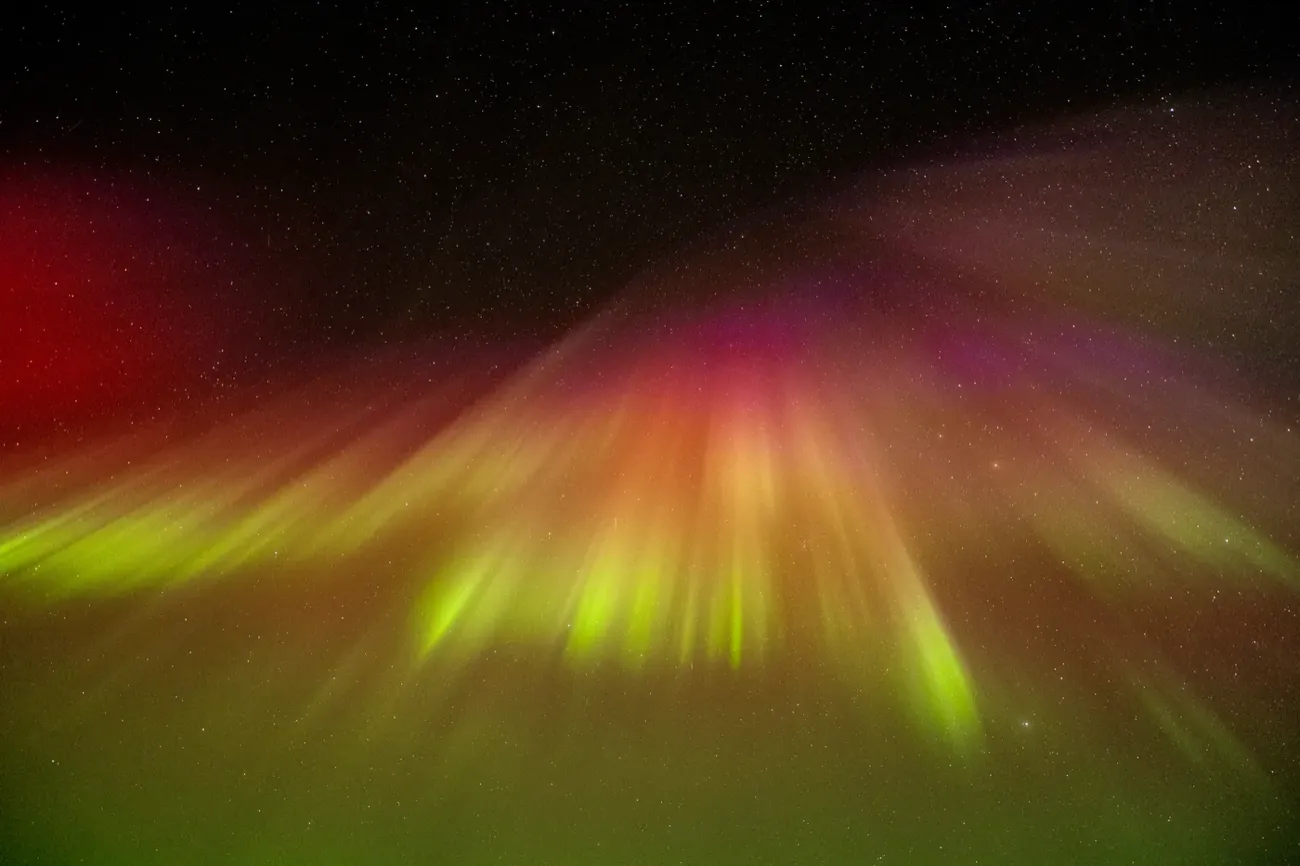
Quick answer: The Kp index is a planetary average, calculated every three hours, and its job is to describe how far south the aurora has been pushed. That matters enormously in Germany or Scotland. In Lapland it matters much less, because Rovaniemi already sits under the auroral oval. The number that actually decides whether the sky opens is Bz, the north–south component of the magnetic field carried by the solar wind. Bz south is written as a negative number (−8 nT), and that is the condition that lights the sky. Bz north is a positive number (+5 nT), and it keeps the door shut. Bz cannot be forecast — it is measured at a satellite 1.5 million kilometres away, which buys everyone 30 to 80 minutes of warning and nothing more.
Key facts at a glance
| Kp index | Planetary average, updated every 3 hours. Describes how far south the aurora reaches |
| Bz | North–south direction of the solar wind’s magnetic field, measured in nanotesla (nT) |
| Bz south | Negative number (−5, −10, −20 nT). The door opens |
| Bz north | Positive number (+3, +8 nT). The door stays shut |
| Warning time | 30–80 minutes, most often about an hour |
| Where Kp matters most | Mid-latitudes — Germany, Scotland, the northern United States |
| Where Kp matters least | Under the oval — Rovaniemi, Tromsø, Fairbanks |
| Statistically strongest months | September, October and March |
What the Kp index actually measures
Every aurora app puts one number in front of you: Kp, on a scale from 0 to 9. It is a real measurement, not marketing. But it answers a different question than the one you are asking.
Kp is calculated every three hours from a network of magnetometers, most of them at mid-latitudes — places like central Europe and the northern United States. It measures how much the Earth’s magnetic field is being disturbed at those latitudes, and from that it infers how far from the poles the aurora has spread.
So a rising Kp genuinely tells you something: the auroral oval is expanding southward. If you are standing in Germany, that is exactly what you need to know, because on an ordinary night there is no aurora above you at all. Kp 6 or 7 is the difference between nothing and something.
Why Kp matters less the further north you go
Rovaniemi is at 66.5°N, on the Arctic Circle. On an ordinary quiet night the auroral oval is already overhead or just to the north. The aurora does not need to be pushed south to reach us — we are underneath it to begin with.
Think about what actually changes on a better night here. On an average night the aurora shows in the northern sky. On a better night it is directly overhead. On the best nights it fills the whole sky, in every direction. Notice that none of those steps is about going further south — which is the only thing a rising Kp really describes.
The Finnish Meteorological Institute puts it plainly in its own daily space weather review: in Lapland the aurora is common even when space weather is calm. A guest who has been refreshing a Kp app all week and sees Kp 2 forecast for their tour night has usually concluded the trip is a write-off. It is not. Here, cloud is what decides, not Kp.
Bz: the number that actually decides
The solar wind is a continuous stream of charged particles leaving the Sun, sometimes from a coronal hole — an opening in the Sun’s atmosphere where the wind escapes faster — and sometimes from a coronal mass ejection, a single violent eruption. Either way, the wind carries the Sun’s magnetic field with it.
What matters when that field arrives is which way it points. Bz is the north–south component of it. When Bz points north, Earth’s own field and the incoming field repel each other, the wind slides around us, and very little gets in. When Bz turns south, the two fields connect — the technical term is magnetic reconnection — and energy pours into the magnetosphere, follows the field lines down to the poles, and lights the air there.
This is why a sustained southward Bz can light the sky on a night whose Kp looks unremarkable, and a northward Bz can keep it dark on a night everyone predicted would be spectacular.
Bz south is a negative number, Bz north is a positive one
This trips up almost everyone reading a live space weather feed for the first time, so it is worth stating flatly. Bz is reported as a signed number in nanotesla (nT). The minus sign is the good sign.
| Bz −15 nT | Strongly southward. The door is wide open |
| Bz −7 nT | Southward. This is the condition that lights the sky |
| Bz −2 nT | Tilting south. Some energy is getting in |
| Bz 0 nT | Neutral. Neither open nor shut |
| Bz +6 nT | Northward. Earth’s field is deflecting the wind and the door is mostly shut |
There is no threshold below which the aurora is guaranteed and none above which it is impossible. But as a rule of thumb, a Bz holding steadily below about −5 nT for a sustained period is what turns a quiet arc into a display worth standing outside for.
The same solar wind, two different nights
Both panels below carry identical wind at identical speed. The only thing that differs is which way its magnetic field points when it arrives — and that is the whole difference between a sky that stays shut and one that opens.
The two fields repel each other. The wind slides around Earth and very little energy gets in — a quiet sky, on a night the numbers may have looked promising.
The two fields connect. Energy pours into the magnetosphere, follows the field lines down to the poles and lights the air there — sometimes on a night nobody predicted.
L1 sits about 1.5 million kilometres sunward of Earth. The wind passes the satellites there 30–80 minutes before it reaches us, and that is the entire warning anyone gets. Diagram, not to scale.
Why Bz cannot be forecast
Here is the part no app will tell you. Bz is not predicted. It is measured, by satellites parked at a point called L1, about 1.5 million kilometres from Earth in the direction of the Sun. The solar wind passes those satellites first, and then still has to cross that distance to reach us.
At typical solar wind speeds of 300 to 800 km/s, that crossing takes between roughly 30 and 80 minutes, most often about an hour. That is the entire warning time anyone on Earth has, whatever an app may suggest. And because Bz can reverse within minutes, an hour-old reading is a snapshot rather than a promise.
So when a website offers you a confident aurora forecast for next Tuesday, it is selling you a number rather than a sky. What can genuinely be planned in advance is everything else: being outside, under a cloud-free sky, in real darkness, with someone reading the live data as it arrives and able to move while there is still time.
What else changes the odds
Solar wind speed
Faster wind carries more energy. Conditions improve markedly above about 500 km/s, and again above 700. A fast stream from a coronal hole can keep activity elevated for days rather than hours.
Density and pressure
A denser stream compresses the magnetosphere and can sharpen a display, making the structures crisper and the movement faster.
The season
Around the equinoxes, the geometry between the solar wind’s field and our own favours southward Bz. This is the Russell–McPherron effect, and it is why September, October and March are statistically the strongest aurora months of the year — not because the Sun is more active then, but because the door is easier to open.
How to read a live Bz reading in practice
If you want to follow it yourself, three numbers are worth watching together:
- Bz — negative is what you want. Sustained below −5 nT is promising; below −10 nT is strong.
- Bt — the total field strength. A large Bt sets the ceiling for how negative Bz can go.
- Speed — above 500 km/s the same Bz delivers more energy.
A Bz of −12 nT with a Bt of 14 nT and wind at 600 km/s is a genuinely good sign for the next hour. The same Bz with Bt of 13 nT and slow wind is milder. And all of it can change before you have finished reading the page.
What this means if you are booking a tour
Two practical conclusions follow from all of the above.
First, do not cancel your plans because the Kp forecast looks low. Under the oval, a quiet sun does not mean an empty sky. Some of the best displays we have seen came on nights the numbers ignored.
Second, the thing worth optimising is cloud, not space weather. You cannot influence Bz and neither can anyone else. You can absolutely influence whether you are standing under a gap in the cloud when it turns south — and that is what a hunting tour is for. We read the cloud forecast across our whole driving range, and we drive to wherever the sky is clearest rather than waiting for it to clear overhead.
You can see the current reading, tonight’s cloud picture and our own judgement for the next three nights on our Rovaniemi aurora forecast page, updated every three hours.
Frequently asked questions
What Kp index do you need to see the Northern Lights in Rovaniemi?
There is no minimum. Rovaniemi sits under the auroral oval, so the aurora is regularly visible at Kp 1 or 2. A higher Kp widens the oval and can make displays reach further across the sky, but it is not a threshold you have to clear.
Is a negative Bz good or bad for aurora?
Good. A negative Bz means the field is pointing south, which lets it connect with Earth’s field and feed energy into the magnetosphere. A positive Bz points north and mostly keeps the wind out.
How far ahead can Bz be predicted?
It cannot be predicted at all. It is measured at L1, which gives 30 to 80 minutes of notice depending on how fast the wind is travelling. Anything presented as a Bz forecast for a specific evening days ahead is guesswork.
Why do aurora apps only show Kp?
Because Kp is a single, simple, three-hourly number that is easy to display and easy to understand, and because for most of the world’s population — who live well south of the oval — it is genuinely the most useful number available.
Does a coronal mass ejection guarantee a display?
No. A CME delivers a large amount of material and can produce spectacular activity, but if its embedded field arrives pointing north, the effect is far smaller than the headlines suggested. The direction still decides.